Where to See Puffins in Iceland, Colony by Colony
Deciding where to see puffins in Iceland sounds simple, because the country holds roughly 60 per cent of the world's Atlantic puffins. It is not. The birds are ashore for four months, they nest in a handful of specific places, and several of the famous ones need a boat, a tractor or a long drive on a road that was gravel until recently. This page compares the seven colonies worth planning around, what each asks of you, and which one gets you closest to a bird.
Quick answer
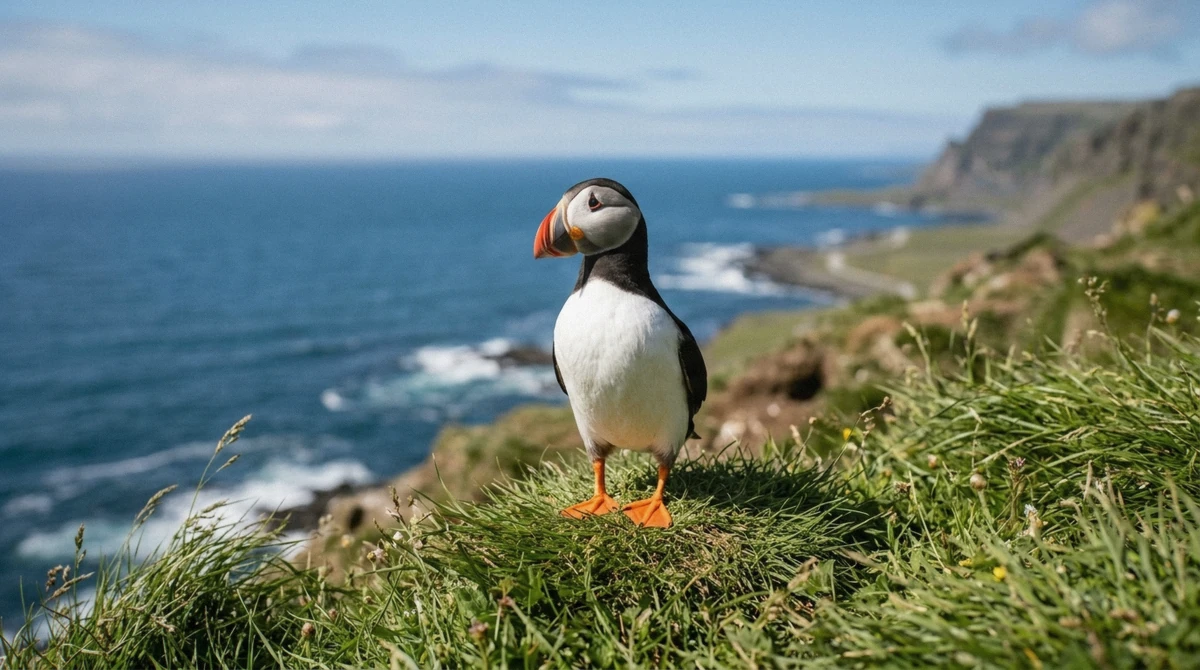
The easiest colony to reach on foot is Hafnarhólmi at Borgarfjörður Eystri in East Iceland, where boardwalks run through about 10,000 nesting pairs and entry is free. The largest is the Vestmannaeyjar archipelago off the south coast, with an estimated 704,000 pairs. Látrabjarg in the Westfjords puts you at eye level on Europe's largest bird cliff. All of them are seasonal: the birds come ashore from mid-April and are gone by mid-August or early September depending on the colony.
Key takeaways
- Closest access without a boat: Hafnarhólmi, where the boardwalks put you a metre or two from the burrows and cost nothing
- Biggest numbers: Vestmannaeyjar, estimated at 704,000 pairs, reached by ferry or a short flight from the mainland
- Best for photographers: Látrabjarg, where the birds sit at eye level on a cliff edge, four hours from Ísafjörður on rough road
- From Reykjavík without a car: boat trips to the islets of Akurey and Lundey run from the old harbour and take about an hour
- Season is mid-April to mid-August at most colonies, stretching into early September in the Westman Islands
- Iceland holds around 60 per cent of the world's Atlantic puffins, a species the IUCN lists as vulnerable
The Short Version
Most people asking this question want one of three things, and the answer differs for each.
If you want to stand next to a puffin, go to Hafnarhólmi. If you want to see tens of thousands of them at once, go to the Westman Islands. If you want the photograph, go to Látrabjarg and accept the drive. Everything else on this page is a variation on those three.
What none of them will do is guarantee you a bird outside the season. Puffins spend eight months of the year on the open Atlantic and come ashore only to breed. In October there is nothing to see anywhere in Iceland, and no operator, boat or ticket changes that.
The Seven Colonies Compared
Access is the column that matters. Two of these need a boat, one needs a tractor, and the rest are a car park and a walk.
| Colony | Region | How you reach it | Season | Scale |
|---|---|---|---|---|
| Hafnarhólmi, Borgarfjörður Eystri | East | Car park and boardwalks, no boat | Mid-April to mid-August | About 10,000 pairs |
| Vestmannaeyjar | South | Ferry from Landeyjahöfn or a flight | May to early September | Estimated 704,000 pairs |
| Látrabjarg | Westfjords | Long drive, then a clifftop walk | Late April to early August | Europe's largest bird cliff |
| Dyrhólaey | South | Car park and a short walk | May to mid-August | Moderate, easy to combine |
| Grímsey | North | Ferry or flight from Akureyri | May to early August | Moderate, on the Arctic Circle |
| Akurey and Lundey | Reykjavík | Boat from the old harbour, about an hour | May to mid-August | Viewed from the water only |
| Ingólfshöfði | Southeast | Tractor-drawn cart across the sands | May to early August | Guided access only |
Hafnarhólmi, Borgarfjörður Eystri
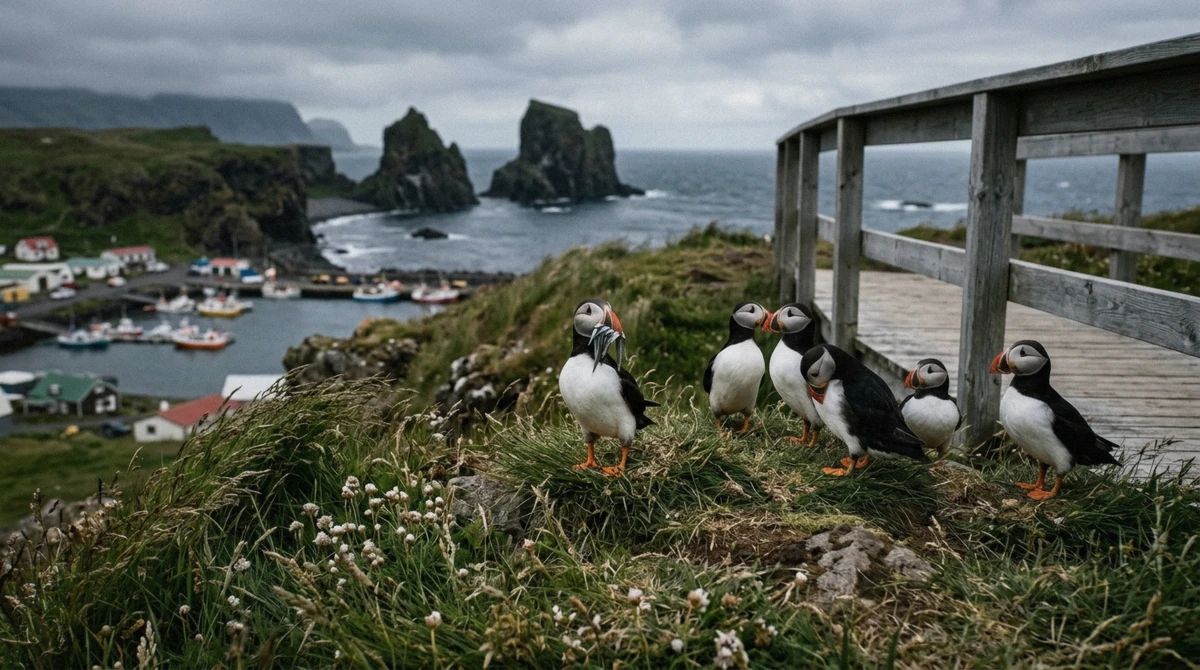
A low rocky peninsula behind a working fishing harbour in the east, and the only colony in the country the village has built boardwalks through rather than fenced off. Platforms sit at several heights among the burrows, there is a wooden hide at the top for weather, and the whole thing is free with donations invited.
About 10,000 pairs nest here from mid-April to mid-August. Because the boards run through the colony rather than around it, birds land within a metre or two of the rail and carry on regardless, which is why this counts as the most accessible puffin watching in Iceland rather than the biggest.
Getting there means Route 94 from Egilsstaðir, an hour and a quarter, or 92.9 km from the cruise pier at Seyðisfjörður. The road was paved in full only in 2023 and still crosses a mountain pass on hairpins. Full detail on the village and the colony is on the Borgarfjörður Eystri page.
Vestmannaeyjar, the Westman Islands
The archipelago off the south coast holds the largest Atlantic puffin colony complex in the world, with the breeding population estimated at around 704,000 pairs. Heimaey, the only inhabited island, has clifftop paths where the birds nest below you in numbers that stop being countable.
The islands run a tradition nowhere else does: in August and early September, pufflings leaving their burrows at night are confused by the town's lights and land in the streets, and local children collect them in boxes and release them at the sea the following morning. That is why the season here runs later than anywhere else.
Getting there means the ferry from Landeyjahöfn, about 35 minutes in good weather, or a short flight. Neither is close to East Iceland; this is a trip in its own right rather than a detour.
Látrabjarg, the Westfjords
Europe's largest bird cliff, at the westernmost point of the country, and the colony photographers plan whole trips around. The puffins nest right at the lip, which means they sit at eye level a few metres from the path and appear entirely unbothered.
That closeness is also the danger. The cliff edge is undercut in places and the turf above the burrows is hollow, and people have died here walking out for a photograph. Lie down rather than lean out, and stay back from any edge that has grass growing over the drop.
The drive is the other cost. Látrabjarg is hours from Ísafjörður on roads that are gravel for long stretches, and there is nothing at the end of it except a lighthouse.
Dyrhólaey, the south coast
The easiest colony to add to an existing itinerary, because it sits on the south coast run that almost every visitor drives. Puffins nest on the grassy slopes below the arch and the lighthouse, and the walk from the car park takes minutes.
Two caveats. Parts of the reserve close during the nesting season to protect the birds, so check before you commit, and the colony is smaller and further from the path than the eastern and western sites. As a stop on a day that was happening anyway, it is excellent. As a destination, it is not.
Grímsey, on the Arctic Circle
An island of a few dozen residents 40 km off the north coast, reached by ferry or a small plane from Akureyri, and the only inhabited part of Iceland that the Arctic Circle crosses. Puffins nest along the cliffs and the walk from the harbour is straightforward.
The appeal is the combination rather than the birds alone: a colony, a circle marker you can stand on, and a boat ride that feels like leaving the country. Day trips are possible and the ferry is weather-dependent.
Akurey and Lundey, from Reykjavík
Two low islets in Faxaflói bay, minutes from the old harbour, and the answer for anyone with a day in Reykjavík and no car. Boats run through the season, take about an hour, and circle the islands so you watch the birds from the water and the air above it.
You will not stand next to a puffin on this trip. What you get is thousands of them rafting on the sea and coming off the slopes in every direction, at a distance that binoculars fix and a phone camera does not.
Ingólfshöfði, the southeast
A headland cut off from the mainland by black sand flats, reached on a cart towed behind a tractor because nothing else crosses the sand. Guided access only, and the guide is usually a farmer whose family has worked the land for generations.
The colony sits among skuas and guillemots on a cliff at the top of a steep sand slope. It is the most unusual approach to any colony in the country and the one that most feels like a trip rather than a stop.
Which One Fits Your Trip
If you are in East Iceland or off a ship at Seyðisfjörður
Hafnarhólmi, without hesitation. It is the only colony within reach and it happens to be the most accessible one in the country. Two coaches run there from the pier, compared on the puffin tour page.
If you have one day in Reykjavík and no car
take the boat to Akurey or Lundey from the old harbour. An hour on the water, thousands of birds, no driving.
If you are driving the south coast anyway
stop at Dyrhólaey and check the reserve is open. Do not reroute a trip for it.
If the photograph is the point
Látrabjarg, and give it two days rather than one. Eye-level birds on a cliff edge is a shot nowhere else in Europe reliably gives you.
If you want the scale of the thing
Vestmannaeyjar, ideally in August when the pufflings start leaving the burrows and the town turns out to collect them.
If your trip falls after the middle of August
plan something else. Most colonies are empty by then and only the Westman Islands hold birds into early September.
Getting Close Without Doing Harm
Puffins dig burrows a metre or so into the turf and raise one chick in each. That is the reason for every rule at every colony, and the reason a hillside that looks like ordinary grass is a roof over a nursery.
- Stay on the boardwalk or the marked path. Turf above burrows collapses under a boot and the chick underneath does not survive it
- Keep back from any cliff edge with grass growing over it. The undercut is invisible from above and it has killed people at Látrabjarg
- Do not use a drone over a colony. It scatters birds off the nests and is banned or unwelcome at most sites
- Sit still rather than approach. Birds that are left alone come closer than birds that are chased
- Keep dogs out entirely, and keep food packed away so gulls do not follow you in
- Take everything back out with you, including the rubbish that blows out of an open bag
It also matters more than it used to. The Atlantic puffin is listed as vulnerable by the IUCN, and Icelandic colonies have had repeated poor breeding seasons driven by sand eel shortages in warming water. Nobody visiting a boardwalk is the cause of that, and the colonies that have invested in boardwalks did so because a managed path does less damage than a hundred people finding their own way in.
What It Costs to See Them
Two of the seven charge nothing at all. The rest cost whatever the transport to them costs, which is the real expense in every case.
| Colony | Entry | What you actually pay for |
|---|---|---|
| Hafnarhólmi | Free, donations invited | The drive: guided trips from the Seyðisfjörður pier run $225 to $227 |
| Dyrhólaey | Free | Nothing, if you are already driving the south coast |
| Vestmannaeyjar | Free on the island | Ferry or flight, plus a night if you want the evening light |
| Látrabjarg | Free | Fuel and hours on gravel from anywhere at all |
| Grímsey | Free on the island | Ferry or flight from Akureyri |
| Akurey and Lundey | Boat ticket | A one-hour trip from the old harbour in Reykjavík |
| Ingólfshöfði | Guided trip only | The tractor ride, which is the only way across the sand |
That pattern holds across the country. Nobody sells you a puffin; they sell you the transport to a free hillside, and the price tracks how remote the hillside is. From the cruise pier at Seyðisfjörður the two coaches to Hafnarhólmi run about $226 for five to six hours, which is what 170 minutes of driving costs on that coast.
Everything running from the pier sits in the comparison of Seydisfjordur tours.
Puffin Questions
Where is the easiest place to see puffins in Iceland?
Hafnarhólmi at Borgarfjörður Eystri in the east. Boardwalks and fenced platforms run through the colony at several heights, there is a hide at the top for bad weather, entry is free, and no boat or hike is involved. Around 10,000 pairs nest there from mid-April to mid-August.
When can you see puffins in Iceland?
From mid-April to mid-August at most colonies, with the strongest numbers from May through July. The Westman Islands run later, into early September, because the pufflings leave the burrows there in late August. Outside that window the birds are on the open Atlantic and no colony has anything to show. The season page breaks it down month by month.
Which colony has the most puffins?
Vestmannaeyjar, off the south coast, with the breeding population estimated at around 704,000 pairs. It is the largest Atlantic puffin colony complex anywhere. Iceland as a whole holds roughly 60 per cent of the world's population of the species.
Can you see puffins from Reykjavík?
Not from the shore, but boat trips from the old harbour reach the islets of Akurey and Lundey in minutes and take about an hour in total. You watch from the water rather than standing among the birds, so bring binoculars if you want detail.
How close can you get to a puffin?
At Hafnarhólmi and Látrabjarg, a metre or two, because the birds nest right beside the path and are used to people. That is close enough for a phone camera. The rule everywhere is to stay on the boardwalk or the path: the turf you would be tempted to step onto is full of burrows with chicks in them.
Do I need a tour to see puffins?
Only where the colony needs a boat or a tractor. Hafnarhólmi, Látrabjarg, Dyrhólaey and Grímsey are all free to walk into once you get there. If you are off a cruise ship at Seyðisfjörður there is no rental desk and no bus, so a guided trip is the only practical route to the east coast colony.
What else nests alongside the puffins?
Kittiwakes, fulmars and common eiders at Hafnarhólmi; guillemots, razorbills and skuas at the bigger cliffs. Half the photographs people bring home from a puffin trip turn out to be of something else, which is not a complaint.